MANUFACTURING
Solar EPC for Factories and Manufacturing Units
Cut industrial tariff costs, claim accelerated depreciation, and run captive solar for industrial operations.
Industrial Energy Costs
Manufacturing plants and small industrial units across industrial estates draw heavy loads from motors, compressors, and process equipment, often pushing them into industrial/commercial tariff categories above Rs 7.50 per unit.
Demand charges based on peak kVA recorded during morning ramp-up create a second cost layer that solar-backed load management can help flatten when paired with intelligent dispatch.
Production managers cannot tolerate unplanned shutdowns. Any solar installation must be sequenced around shift patterns with clear isolation of work zones from active production lines.
Accelerated depreciation at 40 percent in year one makes CAPEX solar especially attractive for profitable small businesses and mid-market manufacturers planning capacity expansion.
Design and Delivery
SolarMaxx maps your load duration curve against irradiance data, sizes captive rooftop or ground-mount capacity for maximum self-consumption, and files metering applications with the relevant DISCOM.
Our project managers coordinate civil, structural, and electrical teams to commission without production loss.
O&M includes monitoring, performance reporting, and scheduled maintenance visits.
Selected Installation
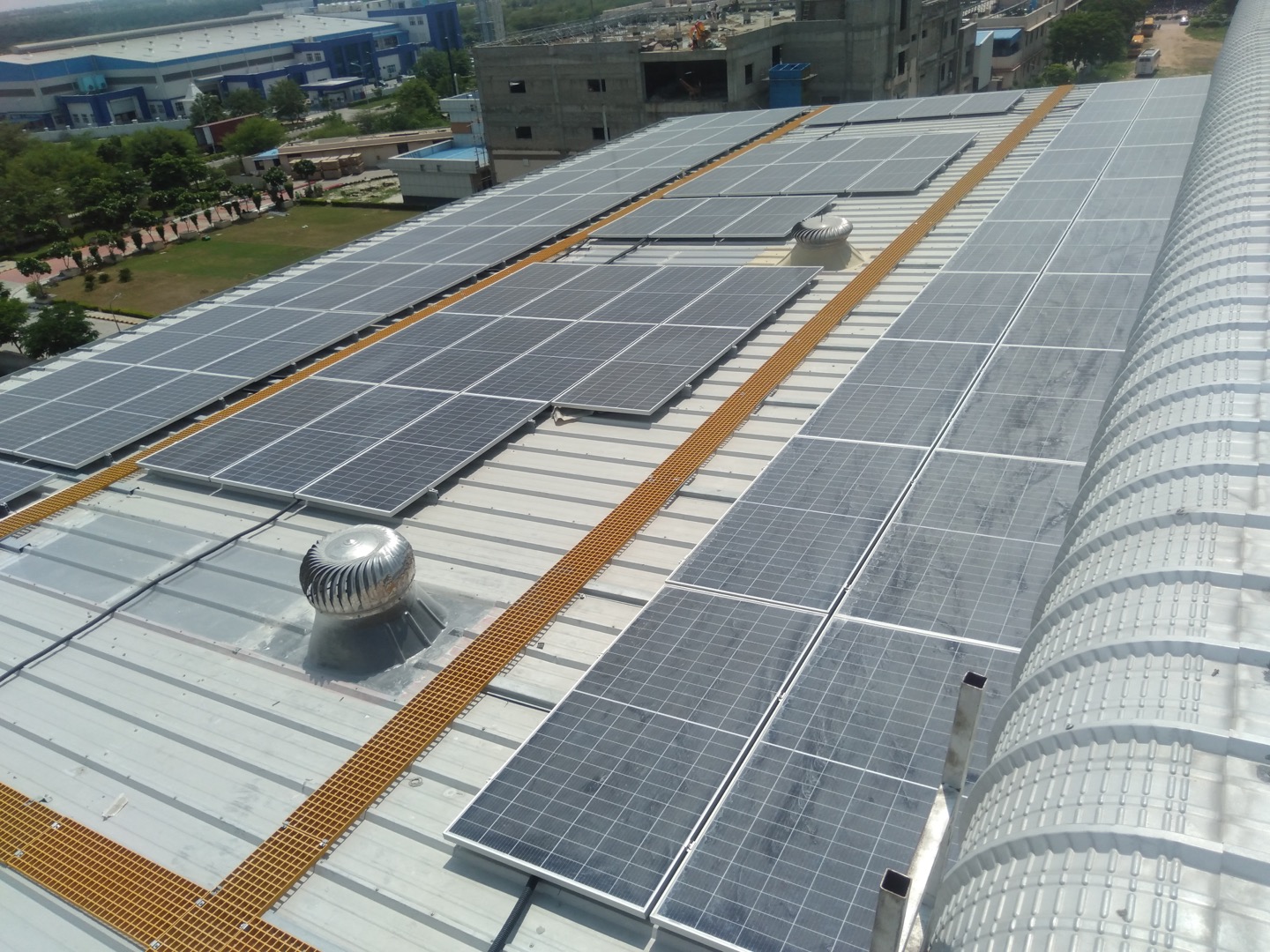
Client: SEZ, Jaipur - 1,300 kW
Challenge: A stone manufacturer operating from an SEZ facility near Jaipur runs a 24/7 high-precision natural and engineered stone plant, where heavy dust deposition and roof orientation constraints made standard rooftop solar design difficult. The SEZ facility added regulatory sanction limits on top of already-tight roof space relative to energy demand, with installation proceeding during the COVID-19 disruption. The client was also concerned about water leakage risk from new tin shed roofing onto sensitive manufacturing machinery, and needed cabling and interconnection completed without interrupting continuous plant operations, all within DISCOM-prescribed timelines. A second tin-shed site in Bagru brought its own challenge: a high roof tilt that introduced safety requirements during installation, while that site was carrying high monthly electricity costs and relying on diesel generators, adding both cost and carbon emissions during grid downtime.
Solution: At the SEZ site, SolarMaxx engineered aluminum structural rails and walkways to evenly distribute roof structural load, paired with an adhesive-based chemical mounting approach specifically to avoid the water leakage risk the client had flagged. SolarEdge module-level power optimizers reduced mismatch losses and maximized output despite the site's dust and orientation constraints. At Bagru, SolarMaxx installed a zero-degree maintenance walkway and safety lifeline system for safe ongoing access and inspection given the roof's tilt angle, alongside a hot-dip galvanized mounting structure and cloud-based intelligent monitoring for real-time performance visibility. Both sites were metered under net metering, with SolarMaxx managing the full documentation process end-to-end, including net metering applications, NOC and demand processing, meter and CT testing, CEIG approvals, and Form-51 completion, with each site commissioned in roughly 3 months.
Outcome: The SEZ installation delivered a 40-50% direct reduction in the plant's annual unit consumption from the grid, backed by module-level monitoring and optimization.
View full case studyTypical System Range
| Typical rooftop area | 15,000 to 80,000 sq ft |
|---|---|
| System size range | 200 kWp to 2 MWp |
| Annual generation | 2.8 to 28 lakh units |
| Technology | High-efficiency modules, central or string inverters |