Sitapura, Jaipur
710 kW
- Commissioned
- 2023
- Modules
- Saatvik 545Wp & 590Wp
- Inverters
- Sungrow
- Mounting
- High-clearance hot-dip galvanized structure
- Metering
- Net metering
- Roof
- Rooftop RCC
- Annual Savings
- Rs. 80 Lakh
- CO2 Offset
- 1,782 tonnes/year
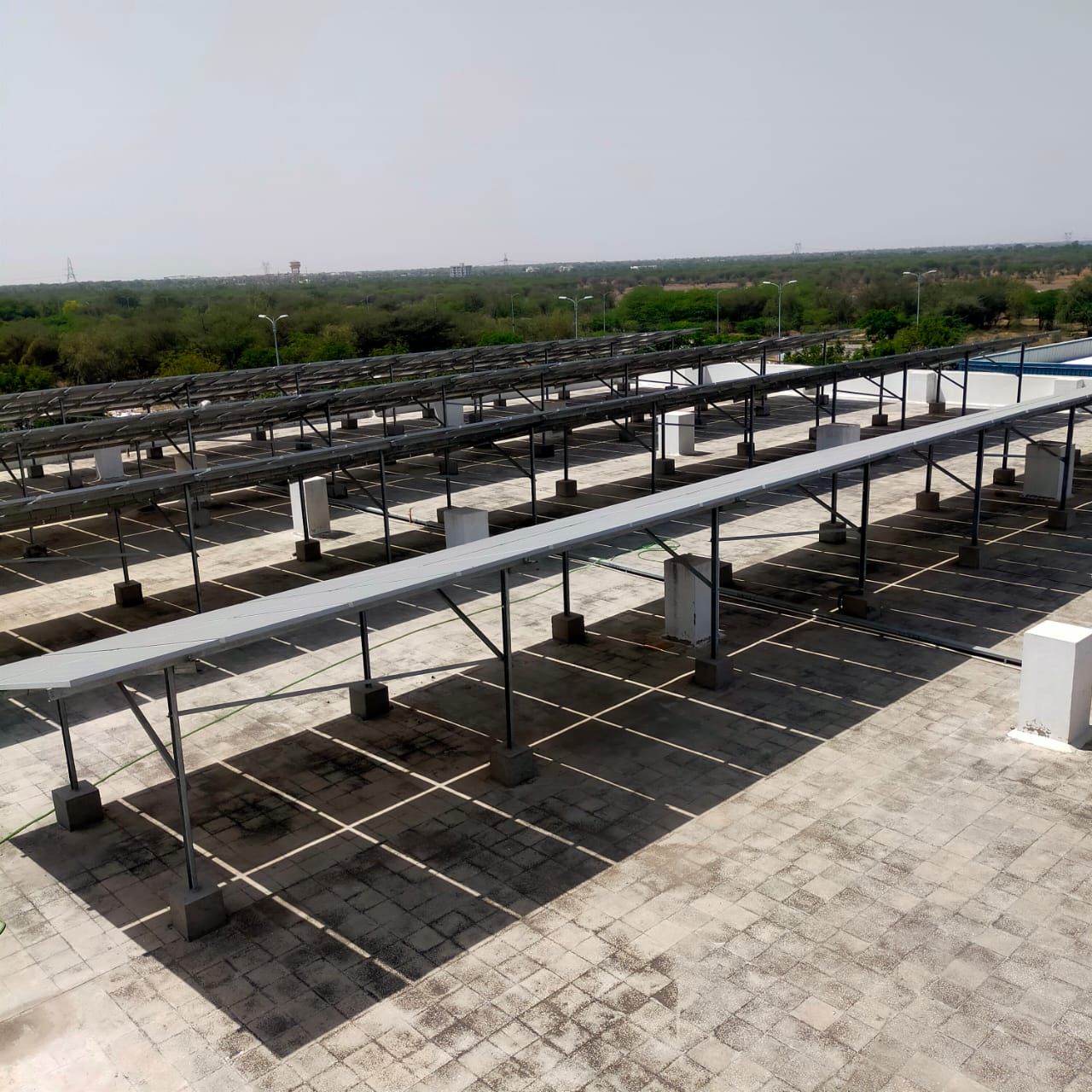
High-clearance rooftop solar that frees space underneath for daily plant work.
SITAPURA, JAIPUR
Manu Yantralaya Pvt. Ltd. runs a manufacturing plant in Sitapura, Jaipur, making automotive and bearing components. The company wanted more solar capacity than the site looked capable of holding, and on an RCC rooftop the limit is rarely the ambition. It is what is already standing on the roof.
Space was the binding constraint. The usable area was limited to begin with, and a lift machine room sat on the roof casting partial shade across part of it. Shading does not just cost the modules directly under it. It pulls down what the surrounding array returns, so the shaded zone effectively removed more capacity than its own footprint.
Non-essential RCC columns took up more of what was left. Clearing them was the obvious way to open up the layout, but this is a working plant on a concrete roof, so anything removed had to come out without compromising structural safety and without interrupting day-to-day operations.
The electrical side carried its own complication. A new three-phase on-grid inverter had to be synchronized with the existing single-phase inverter already running on site, so the new plant had to fit into the electrical system the factory had rather than replacing it.
There was one more requirement that shaped the whole design. The roof was not dead space. It was used, and it had to stay usable for storage and material handling after the panels went up.
SolarMaxx started by making the roof bigger in the only way available, which was to reclaim what was already there. Non-essential RCC columns were safely dismantled and the area cleared, opening up enough usable roof to install maximum solar capacity while holding structural safety and keeping the plant operating throughout.
The mounting was then engineered as a high-clearance structure rather than a conventional low-profile one. Raising the array creates proper working space beneath the modules, so the roof continues to serve storage, material handling, and everyday operations instead of being surrendered to the solar plant. It also maximizes how much of the roof area actually gets used.
Clearance of that kind puts more load on the structure, particularly in wind, so a high-strength module mounting structure was designed and engineered to withstand heavy wind loads and stay stable over the long term. It was built as a hot-dip galvanized GI mounting structure.
On the electrical side, the new three-phase on-grid inverter was synchronized with the existing single-phase inverter so both run as one coordinated system. The plant uses Saatvik 545Wp and 590Wp modules with Sungrow inverters, connected under net metering.
SolarMaxx handled the full documentation and regulatory process end to end: the net metering application, the NOC and demand process, meter and CT testing, the net metering agreement, CEIG approvals, Form-51 completion, and the final metering and protection work.
From site assessment to commissioning took about three months.
The 710 kW plant generates about 2,732 units of power a day and saves close to Rs. 80 lakh every year. It offsets about 1,782 tonnes of CO2.
The capacity came out of a roof that initially looked too small and too obstructed to carry it. Clearing the redundant columns and lifting the array high enough to keep the space beneath it in use meant the plant did not cost the factory anything it was already doing, and synchronizing the new three-phase inverter with the existing single-phase one meant the plant slotted into the electrical setup already in place rather than forcing a rebuild around it.
710 kW


SEZ, JAIPUR
SEZ, JAIPUR
Get a free site assessment and financial model. No obligation. No generic quotes.
Book a Free Assessment